Monoid
A monoid is one of the simplest algebraic structures – a set with an associative binary operation and an identity element. It admits at least three equivalent descriptions, each revealing different aspects.
As a set with a binary operation
A monoid is a set with a binary operation $\langle S,\cdot \rangle$ which satisfies
- Associativity: $(a \cdot b) \cdot c=a \cdot(b \cdot c)$
- Identity element: $a\cdot e=e\cdot a=a$
Roughly, it’s a ‘group-like’ structure without an inverse.
As a one-object category
A monoid is a one-object category. Morphisms in this category correspond to elements of the monoid, and composition corresponds to the binary operation. The identity morphism corresponds to the identity element $e$, and the associativity of composition gives associativity of the binary operation.
 (A group is a one-object groupoid – adding inverses to every morphism turns the one-object category into a groupoid, equivalently turning the monoid into a group.)
Via commutative diagrams
We describe the monoid axioms using commutative diagrams. A commutative diagram asserts that all directed paths with the same start and end yield the same composite morphism. Choose an object $M \in \mathbf{Set}$, and morphisms $\mu: M \times M \rightarrow M$ , $\eta: 1 \rightarrow M$
- Associativity
Commutative diagram:
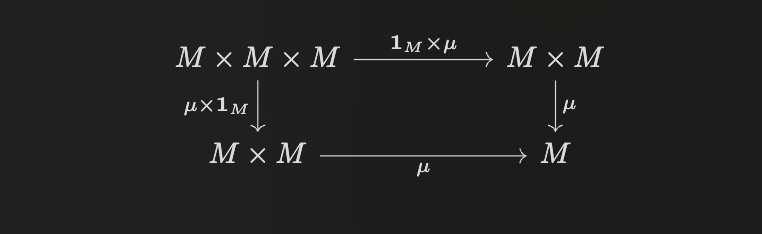 Note: $M \times M \times M \xrightarrow{1_M \times \mu} M \times M$ and $M \times M \times M \xrightarrow{\mu \times 1_M} M \times M$ are not automatically equal. The two maps become equal only after composing with $\mu$; that equality is precisely associativity.
- Identity element $\mathbf{1}$ is the terminal object:
In Set, it is singleton set $\lbrace\rbrace$.
We define $e:=\eta() \in M$. Here $\eta$ is part of the monoid structure – it is chosen data, not merely an existence claim. In $\mathbf{Set}$, morphisms $\mathbf{1} \to M$ always exist (any function from a singleton picks an element of $M$), but $\eta$ specifies which element serves as the identity.
Remark: In a general monoidal category, a morphism from the unit object to a given object need not exist. For example, in certain monoidal categories the unit $I$ may have no morphism to some objects, so the existence of $\eta$ is a genuine requirement. To make $e$ behave like an identity:
\[\mu(e, a)=\mu(a, e)=a \quad(\forall a \in M)\]Commutative diagram:
 Similarly, without this commutative diagram, $\mathbf{1} \times M \cong M \xrightarrow{\eta \times \mathbf{1}_M} M \times M$ and $M \times \mathbf{1} \cong M \xrightarrow{\mathbf{1}_M\times\eta} M \times M$ are not automatically equal.
This diagrammatic definition is the one that generalizes: replacing $\times$ with a tensor product $\otimes$ gives a monoid object in any monoidal category, not just $\mathbf{Set}$.
Enjoy Reading This Article?
Here are some more articles you might like to read next: